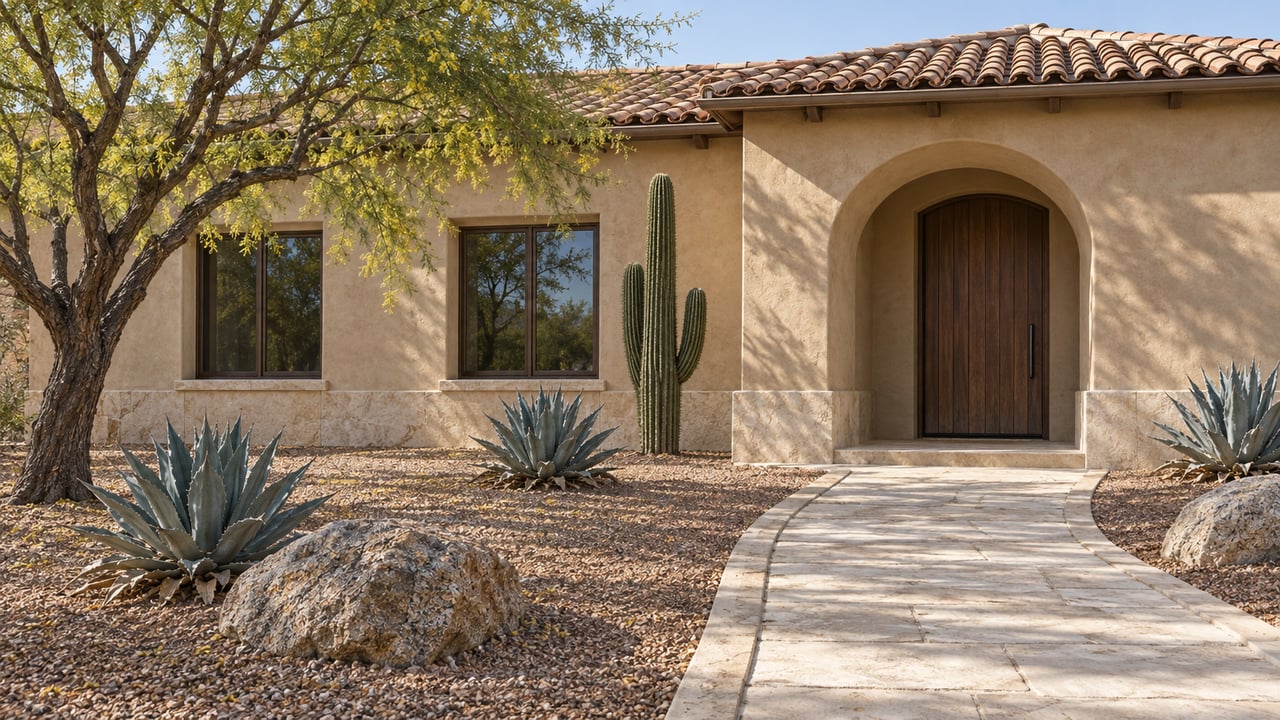
Two Cave Creek homes can show the same price, the same acreage and the same mountain view and still have very different monthly bills. The difference comes from what sits behind each address. One home may get Town water and Town sewer. Another may get water from a separate Town-owned system with higher rates and treat its wastewater with a septic system. A third may run on a private well. And this year, the Town of Cave Creek asked bidders to make offers on all of its water and sewer systems.
That makes the water setup one of the most useful questions to ask about a Cave Creek home this fall. It decides which inspections happen before closing, which forms get filed after, and whose rate schedule sets your bill. The current debate over who should own the pipes adds another layer.
A Cave Creek mailing address doesn't tell you who supplies the water
The Town's own utilities FAQ says it plainly: you may have a Cave Creek mailing address and still live outside the town boundaries. Water service around here follows the history of the old private companies, which doesn't always line up with town limits.
The Town owns and runs two separate water systems and one sewer system. It bought the private Desert Hills Water Company in September 2006 and the Cave Creek Water Company in March 2007. The Town's July 2026 Invitation for Bids describes each one:
| System | Who it serves | Where the water comes from |
|---|---|---|
| Cave Creek Water System | 2,574 metered accounts in town limits and nearby unincorporated areas, plus a few hauled-water customers at a standpipe with limited eligibility | Central Arizona Project (CAP) water, piped 12 miles to the Town's 3 MGD treatment plant |
| Desert Hills Water System | About 1,840 accounts and three standpipe accounts, outside the municipal limits | Groundwater from Town wells, blended with treated CAP water from Cave Creek |
| Cave Creek Wastewater System | 947 accounts within the municipal limits | Treated at the Water Reclamation Facility at 44th Street and Carefree Highway |
Compare the first and third rows. Town water reaches into unincorporated areas, while Town sewer is limited to the municipal limits and has fewer than 1,000 accounts. Having Town water doesn't mean a home is on Town sewer. The Town also notes that many homes and businesses inside its broader service area run on private wells and aren't connected to Town water at all. For any Cave Creek address, confirm the water source and the wastewater setup separately.
The paperwork follows the water setup
Arizona's standard Seller Property Disclosure Statement from the Arizona Association of REALTORS asks the seller to name the water source. The choices are public, private water company, hauled water, private well or shared well. For a private or shared well, the seller is directed to attach a Domestic Water Well/Water Use Addendum. The same form asks whether the home is connected to sewer or served by a septic system, when the system was installed, and when it was last inspected or pumped. Here's what each answer sets in motion:
- Septic. Under Arizona rule A.A.C. R18-9-A316, anyone selling a home with an on-site wastewater system must hire a qualified inspector to inspect it within six months before the transfer. ADEQ's instructions say this rule overrides any conflicting contract terms. The seller gives the buyer the inspection report before closing. The buyer then files a Notice of Transfer within 15 calendar days after the transfer, and in Maricopa County that filing goes to Maricopa County Environmental Services. Forms are on ADEQ's Notice of Transfer page.
- A well on the property. The Arizona Department of Water Resources says change-of-ownership paperwork is filed after the transfer because it requires a copy of the deed. ADWR also says its registry is not a legal determination of who owns a well, and it can't guarantee a parcel has no well. Its advice is that a physical inspection is the best way to find out.
- A shared well. ADWR treats shared-well agreements as civil matters it doesn't regulate. A transfer filing is needed only when the well sits on the parcel being bought.
- Town water. The Town's FAQ gives 480-488-6620 as the water contact, and that's a good first call to confirm which system serves a specific address.
These are rules we report and link, not advice on how they apply to your home. This post is general information, not legal or financial advice, so please confirm your own situation with an attorney, inspector or other qualified professional.
Two Town systems, two different bills
If the home is on Town water, the next question is which Town system serves it, because the rates differ. Under Resolution R2026-01, adopted January 6 and in effect since February 5, 2026, the residential rates for a standard 5/8-inch to 1-inch meter without a booster are:
- Cave Creek Water System: $65.04 a month base charge, plus $2.80 per 1,000 gallons for the first 4,000 gallons
- Desert Hills Water System: $80.76 a month base charge, plus $4.40 per 1,000 gallons for the first 4,000 gallons
On the 2026 schedule, a household using 4,000 gallons in a month pays about $76.24 on the Cave Creek system and about $98.36 on Desert Hills. That's roughly $22 a month apart before usage reaches the higher tiers. The same resolution already sets higher rates for 2027 and 2028 on both systems.
Those are the rates under Town ownership. The Town is now deciding whether that ownership continues.
Why the Town opened the bidding
The decision traces back to the Colorado River. In a March 25, 2026 press release, the Town laid out the problem:
"The Town of Cave Creek is nearly 95% dependent on the Colorado River for its drinking water."
The same release says CAP is expected to cut 2027 deliveries to municipal users by 20 to 57 percent, with deeper cuts possible later. The Town has been negotiating water exchange agreements with Peoria and Surprise and plans to bring one or more Cave Creek wells back into service over the next three to five years. It also says buying new water to make up for the cuts would cost several million dollars. Its Utility Master Plan calls for 1,000 more acre-feet a year on top of the current 2,000 acre-feet of CAP water.
The bidding started smaller. The Town first offered only the Desert Hills system, hoping to keep the roughly 550 acre-feet of CAP water that goes to that area. At the March 25 special meeting, the Council voted unanimously to open the bid to all three systems. It also hired the firm Raftelis for $114,000 to appraise the assets, analyze the bids, compare selling with keeping, and study a bulk treated-water agreement with another city as an alternative.
The bid document lists three Town objectives: get the highest value for the systems, reduce the Town's need to buy new water, and hold down future rate increases. Bidders had to bid on all three systems together, and bids were due September 10, 2026. Each bidder also had to submit a rate plan for after the sale, and that plan counts for 10% of the score. Any future buyer's rates would come from that plan and from whatever regulatory approval the sale requires. The Town's goal of lower increases doesn't guarantee that outcome.
How a sale would happen, and why the timing reaches into 2027
The IFB lays out two possible paths under A.R.S. §§ 9-402 and 9-403. An official appraisal of the utilities' real property decides which one applies:
- If the real property appraises at $15 million or more, the sale needs voter approval at a special election in 2027. If voters approve, the Town auctions the systems to the highest qualified bidder for at least the appraised value.
- If the real property appraises below $15 million, the Council can approve the sale by resolution after at least one public hearing.
On either path, the Town can decide not to sell any of the systems at any point before signing an agreement. The buyer would be responsible for getting Arizona Corporation Commission approval where it's required. In March, the Town said it expected a report on the bids to reach the Council in the fall.
The proposal has drawn public opposition. At the September 1 Council meeting, a representative of West Cave Creek Water, LLC, who also serves as liaison for a future Domestic Water Improvement District, said west-side residents have waited 20 years to join the Town system. He argued that private operation could take away the Town's drought management program and its water-related development rules, recalled multiple outages in 2007 when the system was privately owned, and noted that the Town's intergovernmental agreement with Carefree would complicate a transfer. The September 15 meeting minutes record more public comment against selling the water company. That comment argued the utility isn't straining Town finances, pointed to the Town's $41 million in reserves, and urged the Council to reject any sale.
The Phoenix Interconnect gives the system a second route
Whoever ends up owning the system gets a new piece of infrastructure. The Town said Cave Creek Road would narrow to one lane in each direction near the Phoenix Interconnect site for about two weeks starting October 26. During that time, contractor MGC was modifying a 16-inch waterline, which the Town called one of the last steps of the project. The Town expected to start receiving treated water from Phoenix in early November.
The Town's capital plan explains why the project matters. Before it, the system was exposed to service interruptions whenever either the treatment plant or the CAP pipeline went down. In July 2023, Arizona's Family reported that a storm had damaged a pipeline and that Cave Creek residents were asked to conserve water. The interconnect lets Phoenix treat and deliver up to 1,000 gallons per minute of the Town's own CAP water, about 1.44 million gallons a day. Its approved budget is $22,845,262, funded in part by WIFA forgivable principal, federal recovery funds and $2 million in Congressionally Directed Spending. It gives the system a second route for treatment and delivery. It doesn't add supply to replace what the Colorado River cuts take away.
Quick answers
Does the Town sale affect a home on a private well and septic? The IFB covers the Town's two water systems and its sewer system. A home on its own well and septic system doesn't use any of them, but that homeowner still handles the ADEQ septic inspection and the ADWR well paperwork when the home sells.
Is Desert Hills part of the Town of Cave Creek? The water system belongs to the Town, but it serves about 7.5 square miles of unincorporated county land west of the town boundary.
Will water rates rise in 2027 regardless of the sale? The 2026–2028 schedule the Council adopted already sets higher rates for 2027 and 2028 on both systems.
If you're thinking about selling a Cave Creek home, it helps to know early whether it's on Town water, Desert Hills, a well or septic, because the septic inspection has to happen within six months of closing and shapes your whole timeline. At The Grandon Group, we're glad to walk through your property's water setup when we prepare your free home valuation, so the disclosure and inspection pieces are ready before your listing goes live.