The first house in Arcadia was built for an irrigation foreman. In October 1919, Seymour Jordan and Robert Grace formed the Arcadia Water Company with Mike Krieg and Charles Keafer. They built a home for the man who would run the water, and that house is now part of the Shemer Art Center. Then they started building water lines to serve 1,500 acres north of the Arizona Canal and south of Camelback Road. The land was sold as five- and ten-acre parcels for citrus. Water rights were assigned at one share per acre.
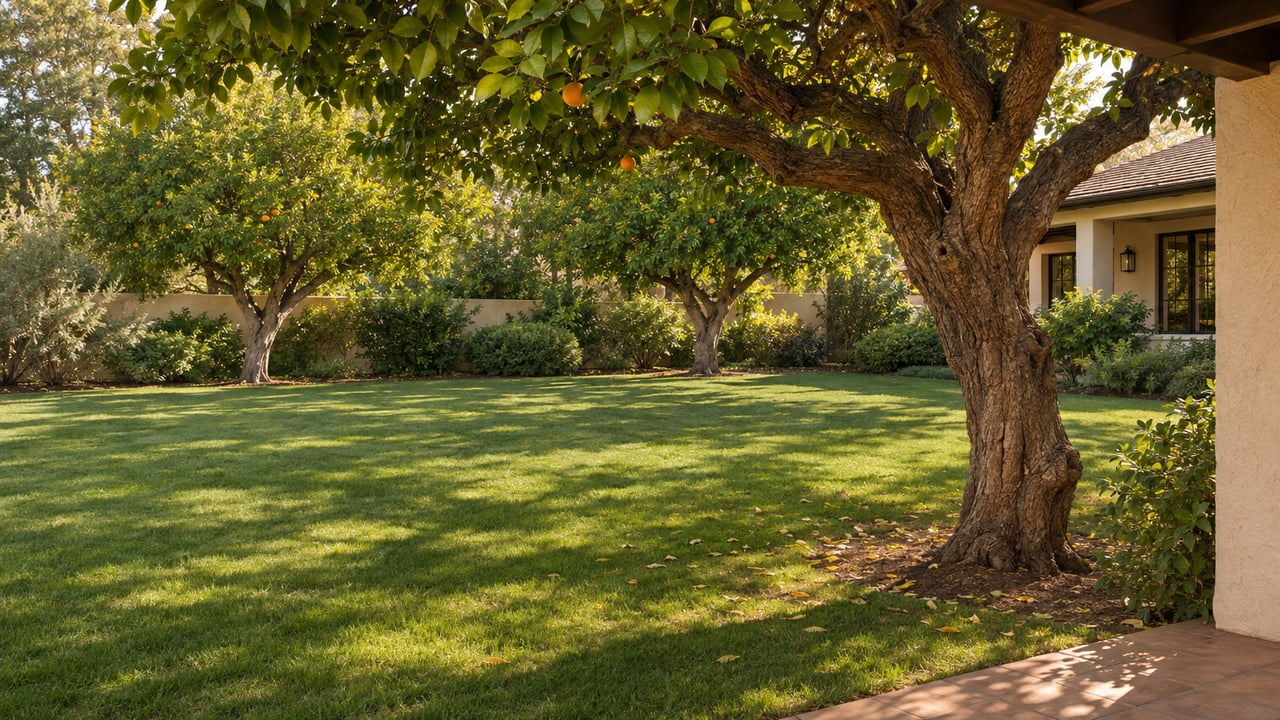
A century later, the mature citrus and wide lawns in Arcadia listing photos still depend on that early water planning. On many lots, the green yard comes from a shared system with its own pipes, its own schedule, its own irrigator and its own budget. A buyer who falls for the yard is also joining whichever system feeds it.
Two systems behind the same green yard
In Arcadia and Arcadia Lite, irrigated yards are usually fed by one of two systems, and you can't tell which from the curb.
The first is the Arcadia Water Company, a nonprofit incorporated in 1919. Landowners inside its district own the rights to the water, subject to the company's fees and rules. It pumps groundwater from its own wells into a reservoir of about 375,000 gallons. Main lines run along Camelback Road to 64th Street, and a lower line turns south and runs over to 44th Street. In the neighborhoods, the company's irrigators open and close the valve at each house.
The second is Salt River Project flood irrigation. SRP sends water by gravity to a neighborhood gate. Past that gate, the ditches, pipes and valves are private, and the irrigating neighbors own and maintain them. Many neighborhoods handle that private side through a county-administered Irrigation Water Delivery District, or IWDD. Two on Maricopa County's 2026 tax-rate list are Arcadia Corners IWDD #81 and Camelview #44.
Arcadia's lots go back to that citrus-era plat, which laid out mostly five-acre parcels west of 56th Street and ten-acre parcels east of it. Those parcels were later subdivided into home lots, and the water systems built for the orchards still reach many of today's yards.
What an irrigated yard asks of its owner
An SRP-irrigated yard comes with its own routine. Subdivision accounts get 18 deliveries a year. SRP rotates the start times, and some deliveries arrive at night. Owners order their water online, by app or by phone, then open and close their own yard valve when their turn comes. SRP's guidance says berms should generally be twice the height of the water being delivered.
The canals also take a winter break. This season's dry-ups run November 20 to December 24, 2026 on SRP's Southside, and January 3 to February 7, 2027 on its Northside. SRP doesn't schedule deliveries during a dry-up.
The SRP bill arrives early. SRP's residential schedule for calendar year 2027 has its first payment due December 6, 2026. For a subdivision account on a 0.40-acre parcel, the 2027 total is $234.66. On a 0.60-acre parcel it's $303.33. If you're buying an irrigated house this season, ask the seller for a copy of that bill. These figures are general information and not legal, tax or financial advice, so confirm a specific property's charges with SRP, the district and your own advisors.
A district run by the people on your street
On many SRP lines, the neighbors themselves keep the water moving past the gate. Arcadia Corners IWDD #81 shows what that looks like. Its private system starts at a standbox near 44th Street and Osborn, and its lines run under streets that include Avalon, Pinchot and Catalina. Volunteer directors run it, and they work with a hired irrigator. At their May 12, 2025 meeting, the trustees approved a levy recorded in the minutes at $237.68 per acre, about $9,500 in total. The same minutes say the district had not yet reached its goal of a $15,000 emergency repair reserve by 2027.
The reserve has a practical purpose. In December 2024, a car crash at 44th Street and Osborn damaged the district's main standbox and suspended delivery for every property served through that SRP gate. The board's minutes say several hundred residents could go without water until it was fixed. The directors authorized the repair right away and pursued reimbursement from the driver's insurer afterward. By February 2026 the board was tracking a possibly recurring leak on Avalon and some gate issues. Its minutes also noted that a gate on east Catalina had been replaced in 2025, and that two residents on Pinchot irrigated on their own instead of using the district's hired irrigator. The board planned to write instructions for self-irrigators and new residents. Buying into a district like this means joining a small volunteer system with its own budget, its own repair list and a published meeting calendar.
The Arcadia Water Company version
North of the canal, the system goes back to that 1919 foreman's house. The Arcadia Water Company lists a $100 membership fee plus water, delivery and repair charges. Shawn Hutt is the operations manager, according to the company's contact page. When the company turned 100, Arcadia News reported that it served around 800 homes and that anyone buying a home inside its service borders received a share of the water. Matt Rizzo, the manager at the time, told the paper, "Because of this company, Arcadia is able to continue to be a greenbelt." The company publishes its delivery timetables by address on its irrigation schedule page.
Why the water source matters more this winter
On November 10, 2026, Phoenix announced that it expects to enter Stage 2 of its Drought Management Plan in January. The City is asking for voluntary reductions in water use, expanding its conservation incentives and planning a surcharge for its highest water users. KJZZ and Cronkite News both covered the announcement. Since a big lawn's water can come from the Arcadia Water Company, an SRP line or a city tap, the source behind a particular yard is worth asking about while you tour this winter.
What to ask about a specific address
Irrigation service depends on the parcel. SRP's Flood Irrigation Signup page points owners to its service map to check a property. For each Arcadia house on your list, get answers to these questions before you write an offer:
- Is the yard served by SRP irrigation, by the Arcadia Water Company, or by neither?
- Which district or company handles delivery, and who is the irrigator?
- What did the most recent irrigation bill and district levy come to?
- Are the berms, the yard valve and the private line to the property in working order?
- When are the next scheduled delivery and the next board or shareholder meeting?
Arcadia's water history comes with the yard. If you're weighing two irrigated Arcadia houses, or wondering how your own irrigated lot figures into what it's worth, The Grandon Group is happy to walk through it with you. Start with a free home valuation.